tsuki, the holy grail.
well... somehow.
Don´t we all dream of mastering the art of tsuki?
I do.
Tsuki is the niche technique in kendo. Rarely seen. Almost never seen in a satisfying manner.
Somehow, tsuki gained popularity again lately.
Maybe it´s due to the latest tsuki ippons, that have been successfully landed in major taikai or it could be a result that comes due to the rise of jodan and nito players. Who knows....
Tuesday, December 1, 2015

Thursday, November 12, 2015
Nito Shinai
Shinai for nito ryu.
Nito ryu requires 2 swords as we all know (Ni = 2 ; to = sword/katana)
I will briefly set an overview here regarding the distinctive shinai used in nito.
According to the regulations for shiai, those shinai must obtain the following measurements
Daito
max. 114 cm
min. 440 gr.(M) / 400 gr.(W)
Shoto
max. 62 cm
280-300 gr.(M) / 250-280 gr.(W)
This of course are the regulations for official shiai!
Lets have a look how they compare to a regular shinai:

Nito ryu requires 2 swords as we all know (Ni = 2 ; to = sword/katana)
I will briefly set an overview here regarding the distinctive shinai used in nito.
According to the regulations for shiai, those shinai must obtain the following measurements
Daito
max. 114 cm
min. 440 gr.(M) / 400 gr.(W)
Shoto
max. 62 cm
280-300 gr.(M) / 250-280 gr.(W)
This of course are the regulations for official shiai!
Lets have a look how they compare to a regular shinai:
Thursday, June 18, 2015
Kirikaeshi and archery
More then often said, Kirikaeshi is the fundamental exercise in Kendo.
If done correctly, there are numerous benefits one can obtain from properly executing Kirikaeshi.
Being exhausting and challenging at the same time, Kirikaeshi will stack the amount of stamina we have and improve the whole body coordination massively.
Now here is the deal, it has to be done "correctly".
Doing it correctly contains numerous points to consider.
After having a nice conversation with my sempai, there is one particular thing I want to share.
If done correctly, there are numerous benefits one can obtain from properly executing Kirikaeshi.
Being exhausting and challenging at the same time, Kirikaeshi will stack the amount of stamina we have and improve the whole body coordination massively.
Now here is the deal, it has to be done "correctly".
Doing it correctly contains numerous points to consider.
After having a nice conversation with my sempai, there is one particular thing I want to share.
Monday, April 13, 2015
carbon shinai
Hasegawa carbon shinai....
Well, carbon shinai have always been polarizing.
90% of the people either like it or hate it.
There aren´t that many people who are "meh" about it, or say there is no big difference compared to bamboo shinai.
My point of view?
Is it better then bamboo? -No.-
Is it a horrible thing nobody needs? -No.-
Do I need on? -Uhhhm, maybe?-
Should I buy one? -At least one, yes (a used one is absolutely OK!)-
Lets start at the very beginning.
Well, carbon shinai have always been polarizing.
90% of the people either like it or hate it.
There aren´t that many people who are "meh" about it, or say there is no big difference compared to bamboo shinai.
My point of view?
Is it better then bamboo? -No.-
Is it a horrible thing nobody needs? -No.-
Do I need on? -Uhhhm, maybe?-
Should I buy one? -At least one, yes (a used one is absolutely OK!)-
Lets start at the very beginning.
Friday, March 27, 2015
Kihon Kata
...to use the full name, which nobody from the outside of japan can ever remember of:
"Bokuto Ni Yoru Kendo Kihon-waza Keiko-ho"
Duh, as everyone does, we´ll stay with the term Kihon Kata.
Ok,
the German Kendo federation decided to have the Kihon Kata added to the kyu-exam content (in Germany you have to run through all 6 kyu grades) from 2016 on.
As the Kihon Kata is relatively new here in Germany, we had an seminar this weekend for all current kyu examiners and those who want to become one.
As most of us are doing Nihon Kendo Kata on a regular basis, the handling of the bokuto was no problem.
Also the single techniques are basically all "well" known.
What we had to learn were "merely" the sequences by itself.
To be Honest, the hardest part for me is to remember the order of the katas by itself, luckily each kata will be announced prior to performing it, hooray!
The concept behind these katas is, to teach various techniques to the beginners by the sword (bokuto).
Many people think it´s rather arguable to expect the beginners, who barely can handle the shinai, to additionally get used to handle the bokuto in a proper way.
One the one side, yes, it can be a bit too much for some people.
But on the other side, it is absolutely important to teach that kendo is based on actual swords fighting and the shinai is just an replacement for save training.
Otherwise it would obviously be called "shinaido" or "shinaijutsu".
Another important point for the beginners is, that due to the lesser complexity of the Kihon Kata compared to the Nihon Kendo Kata, the handling of the bokuto will be easier to learn and be something they are used to when learning the Nihon Kendo Kata.
In conclusion, Kihon Kata is actually really helpful (for the beginners) for getting used to the bokuto/katana, the waza in kendo and proper maai.
Unfortunately, I don´t see any Interest among our advanced kenshi and Dan holders on practicing the Kihon Kata.
Which is really a pity.
I mean, at least the proper execution of the kaeshi and nuki Katas can be a real benefit for the shinai kendo. I rarely see people doing those waza in a proper manner during ji-geiko...
So,
please minna-san,
don´t skip the Kihon Kata!!
"Bokuto Ni Yoru Kendo Kihon-waza Keiko-ho"
Duh, as everyone does, we´ll stay with the term Kihon Kata.
Ok,
the German Kendo federation decided to have the Kihon Kata added to the kyu-exam content (in Germany you have to run through all 6 kyu grades) from 2016 on.
As the Kihon Kata is relatively new here in Germany, we had an seminar this weekend for all current kyu examiners and those who want to become one.
As most of us are doing Nihon Kendo Kata on a regular basis, the handling of the bokuto was no problem.
Also the single techniques are basically all "well" known.
What we had to learn were "merely" the sequences by itself.
To be Honest, the hardest part for me is to remember the order of the katas by itself, luckily each kata will be announced prior to performing it, hooray!
The concept behind these katas is, to teach various techniques to the beginners by the sword (bokuto).
Many people think it´s rather arguable to expect the beginners, who barely can handle the shinai, to additionally get used to handle the bokuto in a proper way.
One the one side, yes, it can be a bit too much for some people.
But on the other side, it is absolutely important to teach that kendo is based on actual swords fighting and the shinai is just an replacement for save training.
Otherwise it would obviously be called "shinaido" or "shinaijutsu".
Another important point for the beginners is, that due to the lesser complexity of the Kihon Kata compared to the Nihon Kendo Kata, the handling of the bokuto will be easier to learn and be something they are used to when learning the Nihon Kendo Kata.
In conclusion, Kihon Kata is actually really helpful (for the beginners) for getting used to the bokuto/katana, the waza in kendo and proper maai.
Unfortunately, I don´t see any Interest among our advanced kenshi and Dan holders on practicing the Kihon Kata.
Which is really a pity.
I mean, at least the proper execution of the kaeshi and nuki Katas can be a real benefit for the shinai kendo. I rarely see people doing those waza in a proper manner during ji-geiko...
So,
please minna-san,
don´t skip the Kihon Kata!!
Monday, March 23, 2015
European stiffness
So,
as we had the honor of hosting the All German Kendo Championship here in Berlin 2 weeks ago, I had the chance to see some rather good kenshi in action.
A lot of good fights have been fought, and seeing the German national team is also a good inspiration.
As an icing for the cake, we had visitors from Japan, 2 hachi-dan sensei and about 30 students from Osaka, with which we had about half an hour of ji-geiko.
An amazing opportunity by the way.
Even if both of them, the Japanese guys and the German national team members showed a high level of skill, there is this fine and distinctive difference between the Japanese and the European kendo.
At best, kendo -should- look the same everywhere on earth, and I think the higher the dan grades get, the more even it looks. But there are not that many nana-dan here in Germany to compare with Japanese sensei.
Anyhow,
I´m still trying to figure out why exactly the Eurokendo looks sort of different than the Japankendo.
But what I can conclude so far is the stiffness.
European kenshi are stiff.
Mostly our arms are the main point, too me.
We use too much strength to achieve a proper tenouchi. If I´m watching the japanese kenshi, or take a look at Chiba-Sensei on youtube, there is this distinctive looseness japanese kenshi have.
Not meant in a bad way, as if they would slack of.
I´ts more that you can feel the inner tension, as if they are tensed up like a spring, combined with a relaxed body which will only tense up at the moment of impact.
This always amazes me over and over again and gives me something I´m trying to achieve.
Inner core tension, outer relaxation....
I´m still trying to figure out why exactly the Eurokendo looks sort of different than the Japankendo.
But what I can conclude so far is the stiffness.
European kenshi are stiff.
Mostly our arms are the main point, too me.
We use too much strength to achieve a proper tenouchi. If I´m watching the japanese kenshi, or take a look at Chiba-Sensei on youtube, there is this distinctive looseness japanese kenshi have.
Not meant in a bad way, as if they would slack of.
I´ts more that you can feel the inner tension, as if they are tensed up like a spring, combined with a relaxed body which will only tense up at the moment of impact.
This always amazes me over and over again and gives me something I´m trying to achieve.
Inner core tension, outer relaxation....
Monday, March 16, 2015
Finally back online!!!!
Minna-san, gomenasai!!!!
For whatever reason, I wasn´t able to log in nor post enything per mail or something :(
Please excuse the long abstinence, I´ll start posting again as soon as possible!
Thanks for the constant visiting anyhow :)
Arigato de gozaru!!!!
For whatever reason, I wasn´t able to log in nor post enything per mail or something :(
Please excuse the long abstinence, I´ll start posting again as soon as possible!
Thanks for the constant visiting anyhow :)
Arigato de gozaru!!!!
Tuesday, January 13, 2015
The ultimate kansai-tying guide
First post of the year will be the promised Kansai-How-To (even though with a little delay...)
Happy new year and have fun, ganbatte!!!!

Happy new year and have fun, ganbatte!!!!
Wednesday, December 31, 2014
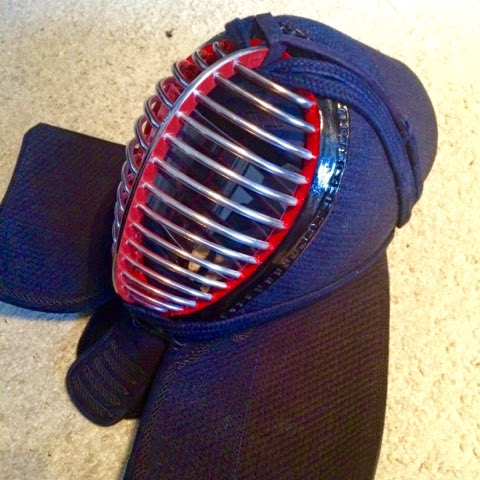
kansai vs kanto
How to tie the men?
We have 2 options, kansai or kanto.
Whats the difference?
Kansai style:
The men himo (8 shaku long) are attached by one single piece of leather at the top of the mengane.

Kanto style:
The men himo (7 shaku long) are attached by two leather pieces at the "cheeks" of the mengane.

We have 2 options, kansai or kanto.
Whats the difference?
Kansai style:
The men himo (8 shaku long) are attached by one single piece of leather at the top of the mengane.
Kanto style:
The men himo (7 shaku long) are attached by two leather pieces at the "cheeks" of the mengane.

Thursday, December 11, 2014
asymmetrical kote
Yesterday,
as I packed my bogu bag after keiko, a question entered my mind.
"Why are kote designed the same for each hand?"
as I packed my bogu bag after keiko, a question entered my mind.
"Why are kote designed the same for each hand?"
Sunday, December 7, 2014
All Japan Pitch nemesis kote - review
These are the most paradox kote ever, wow...
Nemesis, a name that screams business.
The Nemesis gear is (better said was) the 100% shiai dedicated bogu line from AJB.
When there is bogu with added padding and so on for intense Keiko to minimize shinai impact,
then you have the complete opposite with the nemesis bogu.
The idea is to remove everything unneeded and preserve only the bare necessities.
So, you´ll end up with a high performance, ultralight weight and flexible shiai beast of a bogu.
Now the kote:
-full, genuine orizashi reinforced cotton construction
-5mm cross-pitch-stitching
-AllJapan Shin leather (artificial) micro punch palms
-proudly made in Japan

Nemesis, a name that screams business.
The Nemesis gear is (better said was) the 100% shiai dedicated bogu line from AJB.
When there is bogu with added padding and so on for intense Keiko to minimize shinai impact,
then you have the complete opposite with the nemesis bogu.
The idea is to remove everything unneeded and preserve only the bare necessities.
So, you´ll end up with a high performance, ultralight weight and flexible shiai beast of a bogu.
Now the kote:
-full, genuine orizashi reinforced cotton construction
-5mm cross-pitch-stitching
-AllJapan Shin leather (artificial) micro punch palms
-proudly made in Japan

Wednesday, November 26, 2014
AJB bamboo doh - review
I fulfilled myself a long time dream by buying a beautiful bamboo do.

Yes, take do. The pinnacle of kendo gear dreams (affordable dreams, don't even think about same do...).
What do we got:
-60 slate bamboo do-dai
-kiji do-dai covered with a thin layer of ki-urushi lacquer.
-almost plain mune with a thin stripe of same (yes, a little bit of fanciness had to be obtained)
Monday, November 24, 2014
All Japan Pitch guardian kote - review
Let's start with a keen statement:
They are simply the best pair of kote I've ever owned.
Yes they are.
Guardian, a name that promises protection.
A promise you won't be disappointed from.
The guardian series are advertised as having extra protection compared to standard kote.
They are in first place designed for those who often act as motodachi or are mainly on the receiving side.
What do we have:
-full shoaizome orizashi construction
-10mm All Japan Pitch Stitching
-genuine smoked deer skin tenouchi

Sunday, November 16, 2014
don´t compare grades
There is a question that I mostly dislike asking and getting ask.
"What is your grade?"
Well, actually one should assume that ikkyu, shodan, nidan... around the world could be compared directly with each other.
In my opinion this only counts for rokudan and nanadan (we won't talk about way superior hachidan here).
Saturday, November 15, 2014
why take doh is better....(yes, it is)
Alright,

Don't we all truly fancy for a genuine bamboo do?
I allways did and due to the holy and glory times of modern interwebs, the prices for take do dropped from tremendous expensive to at least "affordable".
Except for same do, those thingies still want to be paid with 2000€ and more, wow....
Anyway, after scraping up some leftover cash for a year, I made the order.
What I got really pleased me.
I went for a kiji do (raw hide) with a thin coating of brownish ki-urushi laquer.
The mune is sort of plain with a thin stripe of shark skin (don't blame me, it just looked too nice to me.... And still does).
Here's a picture:
Friday, November 7, 2014
self made eye protector
As far as I can remember, I´ve never ever took part on a single keiko without an eye protector inside my men.
Unfortunately, some greedy kendo shops dare to fetch about 15€ for a single, clear piece of plastic, duh.
I finally tried to copy these by myself, and I think it worked pretty well:
What do we need?
Polycarbonate (PC-Plastic) 2mm (about 17€ for 40cmx50cm - about 9 pieces when cut)
(DON`T use Polystyrene or so called "Plexiglas" which will snap and break easily. Polycarbonate is much more stronger and prone to breaking)
A scriber.
Pliers.
Deburring tool or exacto knife.

Unfortunately, some greedy kendo shops dare to fetch about 15€ for a single, clear piece of plastic, duh.
I finally tried to copy these by myself, and I think it worked pretty well:
What do we need?
Polycarbonate (PC-Plastic) 2mm (about 17€ for 40cmx50cm - about 9 pieces when cut)
(DON`T use Polystyrene or so called "Plexiglas" which will snap and break easily. Polycarbonate is much more stronger and prone to breaking)
A scriber.
Pliers.
Deburring tool or exacto knife.
Step 1.
Lay an old visor onto the plastic for tracing.
Lay an old visor onto the plastic for tracing.
Leave the white foil on, important!
Tuesday, November 4, 2014
straight stick or belly?
Regarding the form of a shinai, we basically have two options to choose from.
Dobari or Koto (we'll ignore Jissen here, which are nothing more than dobari on steroids).
About 2 years ago I decided to switch from the everywhere used dobari-shinai over to the not so often seen koto-shinai.
Initially this choice was purely out of curiosity, but after a while I started see the benefits of these so called koto-shinai.
Most people say, the koto feels heavier than the their dobari counterparts of the same weight, I don´t think so.
Due to the more even weight distribution towards the tip, I personally have the feeling of a certain stronger "pull".
I seems the shinai is pulling me more forward whilst holding a more solid feeling in the tip.
This makes me more confident when obtaining the center line.
In contrast, the dobari seems to have a tip that moves more swift, but I always had the feeling of having a somewhat flimsy tip.
However, this could be just personal...
One point that is clearly on the pro site for koto-shinai is durability.
More mass along the front section makes the shinai less fragile (less breakage).
Of course, even the beefiest shinai may break easy (and eventually it splits anyway), but under the same circumstances, they should last a bit longer.
I wonder why most of theyounger sport orientated kenshi I see mainly use dobari/jissen shinai, but 95% of sensei and other kodansha are mainly using koto-shinai......
Initially this choice was purely out of curiosity, but after a while I started see the benefits of these so called koto-shinai.
Most people say, the koto feels heavier than the their dobari counterparts of the same weight, I don´t think so.
Due to the more even weight distribution towards the tip, I personally have the feeling of a certain stronger "pull".
I seems the shinai is pulling me more forward whilst holding a more solid feeling in the tip.
This makes me more confident when obtaining the center line.
In contrast, the dobari seems to have a tip that moves more swift, but I always had the feeling of having a somewhat flimsy tip.
However, this could be just personal...
One point that is clearly on the pro site for koto-shinai is durability.
More mass along the front section makes the shinai less fragile (less breakage).
Of course, even the beefiest shinai may break easy (and eventually it splits anyway), but under the same circumstances, they should last a bit longer.
I wonder why most of the
Friday, October 31, 2014
the shinai, weapon of choice
There are
tons of sorts of shinai out there, but how to choose?
The best
answer given is probably, choose one you´re comftable with.
That’s
rather easy if you are lucky enough to have a well equipped kendo-store near
your home.
Visit, pick
up many different shinai and buy one that suits your fancy, presto.
If you´re
not in this rather enjoyable situation, the big journey starts.
Check an
online store, order different shinai, realize after the first few keikos that 4 out
of 5 shinai you´ve
ordered are not what you’re looking for.
Repeat......... oh boy.
Second to
this issue, most of us go through different stages of kendo and will
mention a constant change of the needs and fancy´s they have.
I´ve always
been rather picky on which shinai I´m going to buy or I´m going to use.
But I think
I finally found my preferred setup.
Lately I
started to feel most comftable with the following:
39 Kotogata
shinai, 26mm round handle with 38 tsukagawa.
I´ll make
several different upcoming posts about the differences and pros/con regarding
everything,
so stay tuned
first step.....
Well.....
after stumbling around on tumblr for a while now andbeing somewhat unsatisfied with it wanted to do something different , I finallly managed to set up this blog (or better said, I am still setting it up...).
Please don´t expect too much in the beginning, but when the machine starts to runs, I´ll try to post all the things I consider to be related to kendo, my big passion.
So long.....
after stumbling around on tumblr for a while now and
Please don´t expect too much in the beginning, but when the machine starts to runs, I´ll try to post all the things I consider to be related to kendo, my big passion.
So long.....
Subscribe to:
Posts (Atom)